

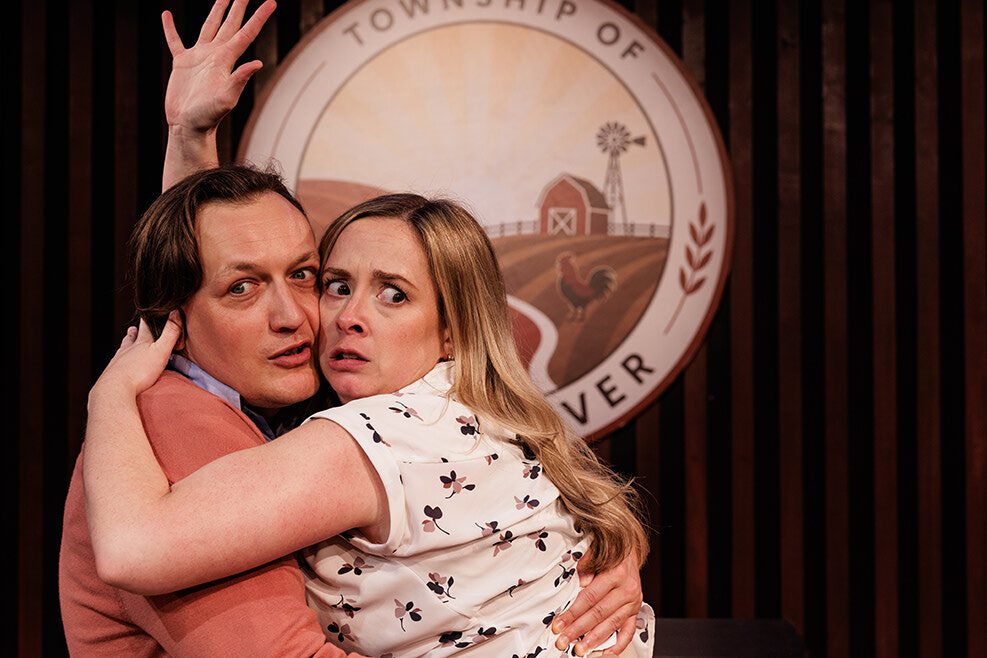
'The Last Mayor of Rusty River' pokes fun at municipal politics in fun romp
BY SHAWN LOUGHLIN
Chris, a friend of mine who has blazed an impressive career in advertising, has always pushed back whenever I tell him to give Mad Men - one of my absolute favourite shows and routinely cited as one of the best of all time - another try. The first time he did, he couldn’t shake the feeling that the stories of advertising executives navigating Manhattan in the 1950s and 1960s were too close to the ones he lived every day. He felt like he was at work and that turned him off; it was just way too close to home.
Let me tell you, when I sat down in Memorial Hall on Friday night, directly facing a fully “functional” council chambers that felt pretty clearly modelled on what is now Huron East Council chambers - it would have been Seaforth Town Council chambers when David Scott, the playwright, was a mayor and local reporter there - it felt like some combination of being triggered and having intense, vibrant flashbacks.
Luckily, my experience with The Last Mayor of Rusty River was not analogous to Chris’s with Mad Men.
My first day as a reporter with The Citizen was Monday, Oct. 2, 2006. On the evening of my second day, Tuesday, Oct. 3, I attended my first Huron East Council meeting. (Treasurer Brad Knight presented the year-to-date budget and, I’m happy to report, things appeared to be on target.)
Written by the aforementioned Scott, alongside Artistic Director Gil Garratt, who also directs the show, and featuring songs by John Powers, The Last Mayor follows a very distinct structure. Both acts are in council chambers, however, the first act comprises two council meetings and the second is entirely an all-candidates meeting - it is an election year after all.
There is a shorthand employed in this play in which I am fluent. Bylaws, committee of the whole and in-camera meetings, feasibility studies, putting motions on the floor, seconding those motions, conflicts of interest and, as a reporter, waiting outside council chambers until a closed-to-the-public meeting has concluded. Right off the bat, I wondered if the average theatre-goer would get up to speed on this jargon in enough time to keep up with the play. To say that someone like me is the target audience for a play like this would be grossly understating it.
Immediately, we’re introduced to two stalwarts of local council meetings. First, there is the struggle between the old guard and the new guard and, second, there is the frustration with the never-ending carousel of inanity - discussion upon discussion, followed by a motion to consider a request for proposals for a feasibility study to determine if council should consider doing something instead of just, you know, doing it in half the time for a quarter of the cost - that some find essential while others consider it soul-crushingly wasteful and unnecessarily time-consuming.
The first act is fun. It introduces us to all of the main characters in short, efficient order, while keeping us guessing as to the twists and turns of this small town and the people charged with running it. It’s also a great showcase for Powers’ music, which is uniformly great from the opening number to the raucous closer that demands the audience sing along.
It’s full of jargon specific to municipal politics and the play doesn’t hold your hand, but it’s also clear enough through its intentionality and the performances of the other actors working off-ball - as another actor is talking - make it clear to those not well versed in this specific kind of terminology.
The second act is a bit more of a roller coaster ride. The all-candidates meeting is wild and unruly with hilarious peaks and a few unnecessarily time-consuming valleys that can be expected when a 19-year-old cat is unwittingly thrust into a municipal election. Again, speaking of intentionality as someone who has attended more all-candidates meetings that anyone should have to in one lifetime, perhaps this inability to find one’s footing and progress the story with the efficiency of the first act is intentional. Real-life all-candidates meetings are awkward, sloppy and often unmanageable; so is this one, though, very unlike actual all-candidates meetings, this one does eventually reach a satisfying, productive conclusion. A conclusion that evokes this exchange from, you guessed it, Mad Men. “Young men love risks because they can’t imagine the consequences,” and the response of, “And you old men love building golden tombs and sealing us in with you.”
Benedict Campbell is exceptional as the seasoned, too-comfortable mayor, perfecting the folksy, reassuring way municipal (and even some provincial) politicians will interact with you. Hallie Seline is also tremendous as the plucky upstart councillor with her eye on the mayor’s chair. The rest are also good as Cam Laurie shares Seline’s youthful frustrations, David Kirby serves as Campbell’s long-time deputy-mayor with a cringey sense of humour and Robin Craig endures the slings and arrows of council as its seasoned chief administrative officer.
Brontae Hunter, I’ll say, after a great turn in Dry Streak, is criminally misused in this one. The decision to have her sit in the front row, essentially among the audience, for the first act is an interesting one that results in most of us not being able to really see her. In the second act, she trades the pen and pad of a print journalist for the selfie stick and over-the-top persona of a livestream reporter for the all-candidates meeting. The transition is clearly intentional - and maybe this is just coming from a 20-year reporter - but this seems like a missed opportunity to give a small-town reporter a real identity instead of treating them as a caricature. We can be interesting people too, I assure you.
The Last Mayor of Rusty River is funny, timely and has its finger on the pulse of living in this community - largely due to Scott - and the unique challenges we face, and yet I can’t help but feel there’s a ceiling for this show that it didn’t quite hit. Having said that, it’s definitely worth your time and locals will appreciate all that it has to offer them.