

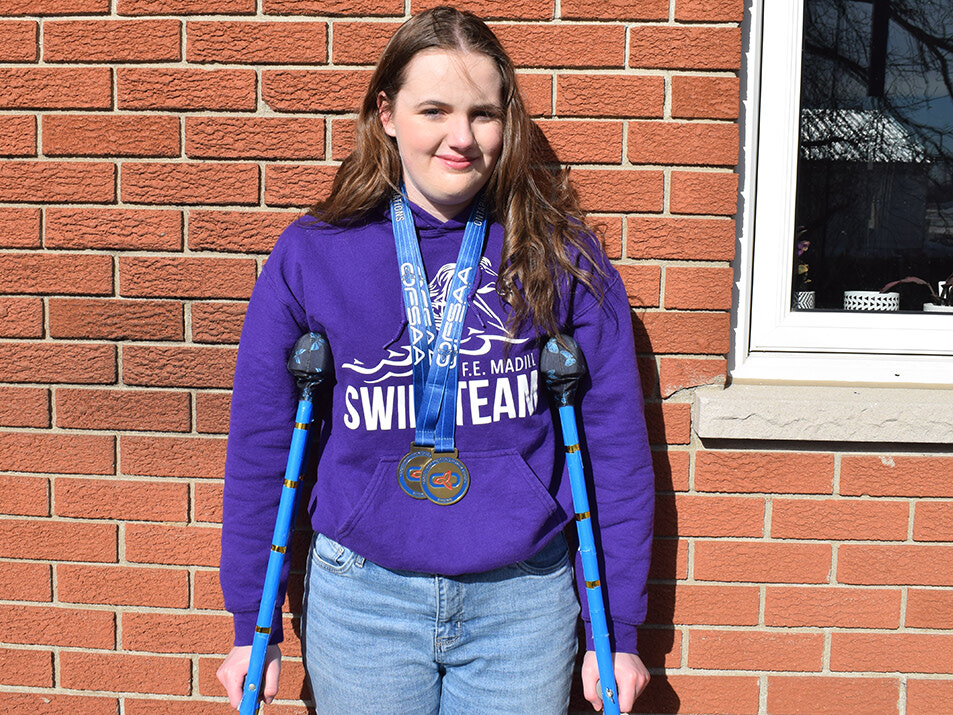
Madill's Ainsley Garniss wins OFSAA para-swimming gold, reflects on journey
BY SCOTT STEPHENSON
Recently, F.E. Madill’s own Ainsley Garniss went to the Ontario Federation of School Athletic Association (OFSAA) Swimming Championship in Windsor and brought home gold. For her first time competing in the massive provincial meet, Garniss captured a pair of para-swimming titles - one in backstroke and one in freestyle.
Shortly after the high school student’s return from the big event, The Citizen caught up with Garniss and her parents, Adam and Cheryl, on the family farm for her first-ever sports interview - though, judging by the hardware she brought home from Windsor, it likely won’t be her last.
Ainsley’s double victory is all the more impressive considering how much this winter’s weather interfered with her training in Wingham. “We didn’t get much practice this year because of all the snow days,” Ainsley told The Citizen. “We were still able to go to the pool on some of the snow days when it was open and train, but it meant that I didn’t get to train with other kids all the time, which is some of the fun of swimming!”
This winter didn’t just interrupt swim practice - its sudden onset last year also meant the family’s harvest schedule got kicked into high gear. “We were in the buggy every night, running from 3:30 until 10,” she said. Fortunately, it’s one of her favourite jobs on the farm. “I enjoy running the buggy, and harvesting corn takes the longest - we thankfully got it off before the snow came and stayed, but we were only like a week ahead of the snow.”
Wild winter or no wild winter, Ainsley made up her mind to compete at OFSAA this year. The 2026 championship brought out over 2,000 elite student athletes to Windsor. While it was her first time at OFSAA, Ainsley was no stranger to the world of competitive swimming - she got her start when she was just 10 years old.
Like most athletes, Garniss didn’t start with gold medals in mind. She first learned to swim in the family’s backyard pool and through lessons at the North Huron Wescast Community Complex in Wingham. “When I did some of the earlier lessons, I had a lot of trouble putting my face in the water when I began, they tell me,” she relayed to The Citizen. “As I started competitive swimming, I was just jumping multiple lessons at a time, so I didn’t actually complete all of the lessons...”
It was a family trip to Florida that helped her get more comfortable in the water. “I always kind of assumed they just kept dunking me until I was okay with it, but that’s not how getting over fear works,” Ainsley ruminated. “Now I think that’s when I started putting my face in the water - the trip to Florida! Parents can’t just dunk your head underwater - I think it would make it worse!” (Both Adam and Cheryl confirmed that it was Florida, not parental dunkings, that helped their daughter over that particular hurdle.)
Not long after she began to submerge, Ainsley’s interest in swimming had turned from learning into leading; she wanted to compete. “I’ve always loved the competitive aspect of it. I found it hard to stay and train if I wasn’t able to compete,” she confessed. “I started with the Personal Best Club in Wingham. I had done it with a friend, and I really enjoyed it, but I wanted to compete. So I joined the Hurricanes out of Vanastra,” she recalled. “I went to a meet with them in Waterloo in October when I was 10, and I swam two races - it was with all the older kids who were on deck, which is pretty rare.” While she doesn’t recall the results of that event, she does remember how much fun it was.
Her progress continued from there. “We were part of a really small club, so we were just doing smaller meets, but I guess I made Regionals at age 12,” she said. “That’s a time-qualifying meet, and that felt big, but even in the world of swimming, that’s a small pond.”
A few years ago, however, her path in the sport took an unexpected turn. After a knee injury failed to heal, Garniss was eventually diagnosed with Complex Regional Pain Syndrome (CRPS), a rare condition. “It means the nerves in my leg are sending pain signals to my brain without there actually being any injury in my leg,” Ainsley explained. “It started as a knee sprain, and then it just never healed,” she explained.
CRPS can be difficult to diagnose, and it does not show up on standard medical tests. “It took about a year to get diagnosed, because we had to rule out all other injuries,” she said. Ainsley received her diagnosis in November of 2024. Today, when she’s on land, she requires a wheelchair or walker for mobility.
“It’s hard to get your head around,” Adam pointed out. “It took a long time for us to really get into enough understanding to develop a routine and a rhythm around it.” Her father said returning to the water involved more than physical recovery. “A lot of the physios always talk about how the pool is a great place to do physiotherapy, but there was a mental barrier there… she had to go from treating the pool as somewhere she wanted to be swimming and competing and going fast to somewhere that was helping her with her recovery. And that was a difficult process for a teenage girl.”
During that time, Ainsley’s condition forced her to step away from competitive swimming - but only temporarily. The high school swimming offered at F.E. Madill was a way to ease back into her chosen sport, rather than jumping right back into the rigorous practice schedule of competitive-style swimming. “This year was my first year competing as a para-swimmer,” she explained. “I competed as able-bodied until 2024, and then I took two years off and came back for high school this year - and I really enjoyed it! I wanted to do high school last year, but my condition was, like, progressing. But I was trying! It was last November that I actually fully quit training. I quit competing two years ago, but I’ve always loved it, and I love swimming as an escape, so I always knew I wanted to go back.”
And go back she did, in a big way! “I’ve always just enjoyed the environment of a big meet,” she said. “Tuesday went really well. It was really nice that we, as para-swimmers, didn’t race in prelims, so we only had to race finals, which meant we didn’t have to make the 7 a.m. warm up - we got to do the noon one. So we had time to get up and get stuff ready in the hotel room, and it didn’t feel like a really big rush, which was nice. And Wednesday went well, too!”
There was also a small lesson in the finer points of para-swimming rules. Garniss actually finished first in three events, but was later disqualified from the 100-metre freestyle because of an international regulation about how towels must be folded - something she hadn’t encountered before. While disappointing at the time, the family knows better than to dwell on it. “It was a learning experience for a lot of people,” Cheryl pointed out. “And, she was still the fastest in the race,” Adam added.
Looking ahead, Ainsley hopes to return to full-time competitive swimming next year and continue building on her progress. She is also considering a future in agriculture and plans to pursue post-secondary studies in the field. “Then, I’d probably try out for a university team, but they’re really competitive and hard to get on - so you just can’t know,” she said.
For younger athletes thinking about pursuing a competitive sport, Ainsley offers simple advice. “Enjoy it. Especially with swimming - don’t get caught up in trying to beat your teammates,” she said. “Just focus on enjoying it and having fun with them.”
For her family, seeing Ainsley back in the water and flourishing has been a big milestone. “The number one goal - we’re mostly proud of just the fact that she’s back in the pool, and she’s back competing, she’s making progress on healing and getting better,” Adam said. As her mother, Cheryl has had a front row seat for the reigniting of her daughter’s passion for swimming. “When she first started, the joy she had of it, like she just grinned ear to ear for every single practice… it made it pretty easy to put the hours in driving her to and from them, because she was keen all the time. Seeing her back in the pool - it’s beautiful.”
No matter what competition category she’s racing under, the pool is still the place where Ainsley feels the most comfortable.“The rest of the world disappears when you’re swimming,” she explained. “I used to sleep better on nights when I had swimming than when I didn’t… it’s just a break from everything.”