

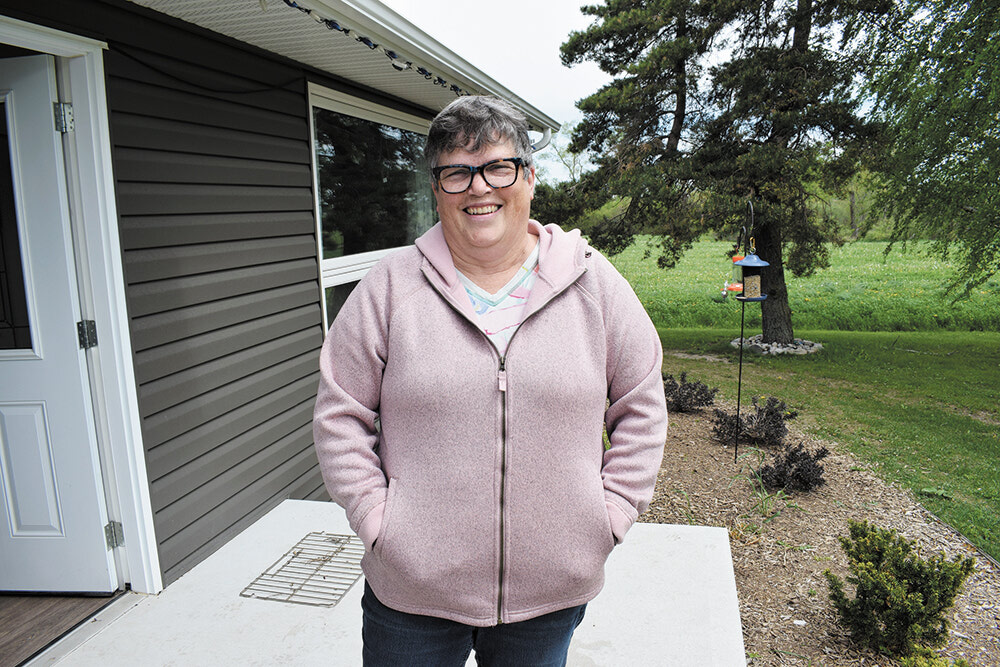
Jennifer Miltenburg reflects on "retirement" for Dairy Month
BY SCOTT STEPHENSON
One of the biggest moments a dairy farmer faces is the passing on of their operation to the next generation. Succession planning is a complex process - for many farmers, it begins when their children are born.
Of course, these days, not every young person wants to take on the mantle of their parents’ agricultural legacy. Jennifer and Don Miltenburg are among the lucky ones - their son Conor took over the family business, Esteem Farms Ltd, four years ago, and things on the farm have been going swimmingly since.
But what becomes of a dairy farmer once they’ve traded life on the farm for the sunny shores of retirement? In search of answers, The Citizen sat down with Jennifer at her home in Ashfield-Colborne-Wawanosh (ACW) to hear about what it feels like to leave it all behind.
The first big bombshell of retiring from the dairy business: there’s no retiring from the dairy business. “I’m retired, so, seriously, I only milk five days a week, and I don’t get profits,” Jennifer declared. “People laugh at me and say ‘I thought you retired?!’ Conor does probably 100 per cent of the cows, probably 50 per cent of the planting, and not nearly as much of the bookwork as I would want him to. So, have I retired?”
When their son Conor took over as president of the company four years ago, it fulfilled his lifelong dream of becoming a dairy farmer. But it was also a big commitment, and that commitment did not come overnight. Jennifer explained that the path to taking over the farm required years of preparation and experience. “He had to get post-secondary, so he went to Ridgetown, out of Centralia,” she recalled. “Then he had to work for someone else for five years. Then he had to work for us for five years.”
Even now, the switch-over remains ongoing, with responsibilities shared among family members. “It has been a transition. “There’s three of us that make the decisions,” she pointed out. “Don and I are more advisory now. Retirement means I get to say, ‘Oh, that cow’s sick. You better do something about it,’ and then go home… It felt like a retirement because I didn’t have to work on the weekends anymore - having said that, I just worked the last two weekends, and I’ve worked 20-something days in a row because the seasons are late and my other son Tristan broke his leg.”
The Miltenburg farm itself has a long history in the community. “Don bought the home farm in 1981. He started milking cows in 1983. I married him in 1984. We became a corporate entity in the 1990s, which just makes it easier to transfer, really,” Jennifer explained.
Over the years, the farm built a reputation for strong herd performance and careful management. Their cows are part of a testing system that compares production and management practices across the county and the country. “We were always in the top 10 per cent of the county - dairy cattle, if you have the genetics, you can probably get 80 to 85 per cent of your production - they want to milk,” she divulged. “What gives you the extra production would be cow comfort, your ration, your breeding program… there’s all sorts of management tools to get them to go higher.”
Around the time that the Miltenburg family was implementing its succession plan, something unexpected happened that forever changed their level of milk production. “What happened was the pandemic,” she recounted. “Because of the supply chain challenges, dairy farmers had to dump milk - we were one of the first people that had to dump the milk, which was very distressing. They cut how much you could send, and we had to sell a bunch of cows, because we had way too many cows.”
Although the financial impact was shared across the system, the uncertainty created significant operational challenges.
“Financially, it was okay, because everybody shared the cost,” she told The Citizen. “But they cut how much milk you could send. They’d say - okay, you can milk this much this month. They figured about 50 per cent of the people would be able to do it, and then they were trying to manage a really irregular milk supply. We had to sell a bunch of cows, because we had way too many cows. And then, two months later, they said, ‘well, we’re going to give you some more - but only for a month. Well, we couldn’t possibly fill that without buying cows. And so I said, ‘well, this isn’t even making financial sense anymore.’”
Fortunately, farmers tend to find their way through uncertain times. Rather than buy more cattle, the Miltenburgs decided to shake things up with the cows they already had. “What we could do is try to milk three times a day, because that bumps up production,” Jennifer explained. “We expected a 10 per cent, possibly 15 per cent increase - it jumped over 20 per cent as soon as we started! We’ve been doing it for over five years now, and the cows have responded tremendously. We were only going to do it for a few months. And then, it was so spectacular we kept going!”
Under Conor’s leadership, Esteem Farms Ltd. is now rated in the top five per cent in the nation by Lacanet. “He’s in the top less-than-one per cent for tie stalls, because we’re using an old tie stall,” Jennifer pointed out with pride. “Nobody milks three times a day in a tie stall! He does extremely well.”
Jennifer also enjoys another benefit to the old tie stall method. “When you’re milking cows like that, it’s really enjoyable, 'cause you're like, ‘oh, wow, look at this cow. Ooh, how much did she get?’ And that’s kind of fun,” she confessed. “Having said that, the shift that I do now is the morning shift. I used to do the 10 o'clock at night shift, because it’s so peaceful. But eventually, COVID ended and we wanted to go places, so we started hiring teenagers. And they didn’t want to get up in the morning. So I took the morning shift, and the teenagers took the night shifts. Now that I’m retired, I do the 5:30 a.m. shift, and that is the only shift I want to do. What I want to do is milk five times a week, two hours, two and a half at most, if there’s a calf, so I’m home by 8 a.m. Beautiful start to the day. They’re very quiet. They’re very peaceful. They’re beautiful animals. No one’s bugging you. It’s really nice.”
Over the years, the Miltenburg clan has weathered many changes in the dairy industry. By today’s standards Esteem Farms is a small operation. “We have an unusual operation,” Jennifer confided. “Dairy cows are on a quota system, which is just a piece of paper. And in the beginning, you couldn’t borrow against it. You couldn’t borrow against your land to buy that piece of paper - you had to have the money for the quota. In 1985, was the General Agreement on Tariff and Trades (GATT) - the GATT talks. Ten years later, it was the North American Free Trade Agreement - NAFTA. They’re always talking about getting rid of the dairy system. So now you’re trying to borrow tons of money on a piece of paper that they can just take away - we went in a different direction, in that we bought land, so we have more land than is usual for a dairy farmer and less cows than is usual for a dairy farmer.”
Their methods may be a tiny bit unorthodox, but the Miltenburgs have found a way of dairy farming that works for them. “Our barn is at capacity, milking three times a day, and we milk 46 cows,” she said. “But with the amount of quota Conor has, most people would milk between 60 and 70. His production is just so off the charts.”
Of course, dairy farming isn’t all high production and quiet mornings spent milking in quiet reflection - every day comes with its own unique set of twists and turns. “Last night, two cows calved, so that added an hour to chores. In our operation, if a cow’s coming on, somebody else has to be moved off, and they have to be dried off,” Jennifer explained.
Then there is the matter of the increasingly unpredictable machinations of our neighbours to the south, which are never far from a dairy farmer’s mind… even a “retired” one. “USMCA is due again this July,” Jennifer pointed out. “Four years ago, honest to God, Trump was at a rally in Wisconsin, and the Wisconsin dairy farmers were saying they want more access to Canadian markets. And Wisconsin is a swing state,” she recounted. “A week later, he said - “we’re not signing anything unless we get concessions from the dairy industry!’ Now, I should tell you that chicken and eggs are under the exact same program. But you never hear a thing about chickens or eggs, even though their eggs down there are quite expensive. But no, he’s all about the dairy. Major concessions were made. And now he hates the dairy farmers!”
Her exasperation over the situation is palpable. “Wisconsin’s production is massive… their overproduction is more than Canada’s production, so it really doesn’t matter to them,” she elucidated. “It does matter to us, but there’s no point explaining that… the biggest challenge to all farmers is actually the United States of America right now.”
The Miltenburg method of labour intensive dairy production is quite time-consuming, yet Jennifer has still somehow found the time to make a big impact in her community over the years. She’s been a longtime member of ACW Council, a vocal green-energy advocate, a founding director of the St. Joseph’s Kingsbridge Community Centre, and, on occasion, an actor.
Of course, it hasn’t always been easy to fit it all into her busy schedule. “When I started on council, the meetings were at 7 p.m., so I had to hire someone to do my work,” Jennifer pointed out. “As it turned out, three of the seven people were dairy farmers. We asked, “Why are we paying people to milk our cows so we can get here?’” It was soon decided that ACW’s meetings would be held in the mornings, at 9 a.m..
Jennifer feels that, as a dairy farmer, it is part of her civic duty to defend the laws and bylaws designed to protect farmers, farmland and agricultural concerns. “There is a Provincial Policy Statement (PPS), and it’s there for a reason. It’s there to protect not only the farms that exist, but protect future farming operations,” she pointed out. “One of the things is that no farms can be under 100 acres, unless it’s from an 1867 census. And, if it’s zoned AG1, which is agriculture, then don’t be putting more houses on it. There are lots that are already zoned residential. Or future residential. Or village hamlet. And they’ve been zoned that way for 150 years. Some people would rather live out in a McMansion with a big lawn, which I really don’t like. I don’t like urban sprawl. The rules are there for a reason - they’re for the protection of the agriculture industry. Unfortunately, there seems to be a trend now to accommodate the individual at the expense of society. The most recent stat that I’ve seen is - Ontario is losing over 300 acres a day, because they keep saying ‘What’s one house? What’s one house?’ Try adding up all the one houses - it’s a disaster.”
Jennifer’s work on council can be looked at as an extension of the succession plan she and Don worked so hard to put into place - defending proper farming practices for the future means the dairy farms of Huron County will have the best chance of continuing to flourish.
Securing the legacy of the Kingsbridge Centre can also be looked at as another type of long-term succession planning. Turning the community’s shuttered church into an artistic hub is just another way to keep young people actively engaged with their community. “There’s something called ‘the third space’,” Jennifer explained. “Your home is your first space, your work is your second space, and then where you go to find your communities - that’s your third space.”
She believes that this third space is a critical part of a healthy, happy community. “It could be the gym, or it could be a coffee shop. In overwhelmingly rural areas, it’s the church, or the school. And both have been closing at an alarming rate,” she told The Citizen. “In our area, Kingsbridge was the third space for a lot of people. It wasn’t just what happened upstairs, it was the community events that also happened. When the Kingsbridge Church closed, there was no space within 15 kilometres in any direction. There was no public space, so that’s why the community came together - they needed a third space.”
Since starting its new life as the multi-use Kingsbridge Centre, the space has hosted innumerable cultural events, including concerts, one-man shows and technology education sessions. Every spring, local farmers, citizens and families get together and spend months rehearsing to put on a big show for the community. While Jennifer has been a cast member of many Kingsbridge shows, she will unfortunately not be performing in the grand remounting of Warren Robinson’s The Great Storm, which begins its two-weekend run on June 5.
“The original intent of all productions at Kingsbridge was community involvement - it was to give people the opportunity to shine who otherwise wouldn’t have had the chance,” Jennifer told The Citizen. “A production generally takes between 90 and 100 volunteers, between the parking and the concessions, the cleaning, the set design, the costumes… we tracked volunteers last year, and I think it was 94 volunteers.”
The annual Kingsbridge musical isn’t just something to entertain locals during the hectic spring planting season - it’s also a place to learn local stories in a communal setting. “The play is usually local history, and it brings out local people,” she said. “So, you see people that you haven’t seen for a while, because our area doesn’t have a church, or a bank. We don’t have a grocery store, we don’t have a doctor’s office. We don’t have anything where you would normally run into your neighbours. Agriculture is a pretty individual, isolating job, and it's really important for mental health to have connections within your community, and doing a play like this, not only fosters that within the actors, but within the volunteers, and within all the people who are just so happy to see each other. It's a joyous occasion.”
As she reflects on both her years in the dairy industry and her community work, Jennifer believes the twin keys to keeping it all together are balance and passion. “I think the most important thing is to find something you love, with people who care.
Because, otherwise, it’s just unpaid labour,” she mused, “And there are volunteer opportunities everywhere - there’s a desperate need everywhere. I used to say ‘yes’ to way too many things. So, do it as long as it brings you joy. And when it doesn’t, then maybe your time there is done, and it's time for something else. Find what brings you joy, and go do it.”
While Jennifer Miltenburg will most certainly be found in the barn most mornings for the foreseeable future, there might be big changes ahead. “Conor’s actually pricing out a robot barn for next year,” she said. “Maybe that’s when I'll retire.”
Maybe.