

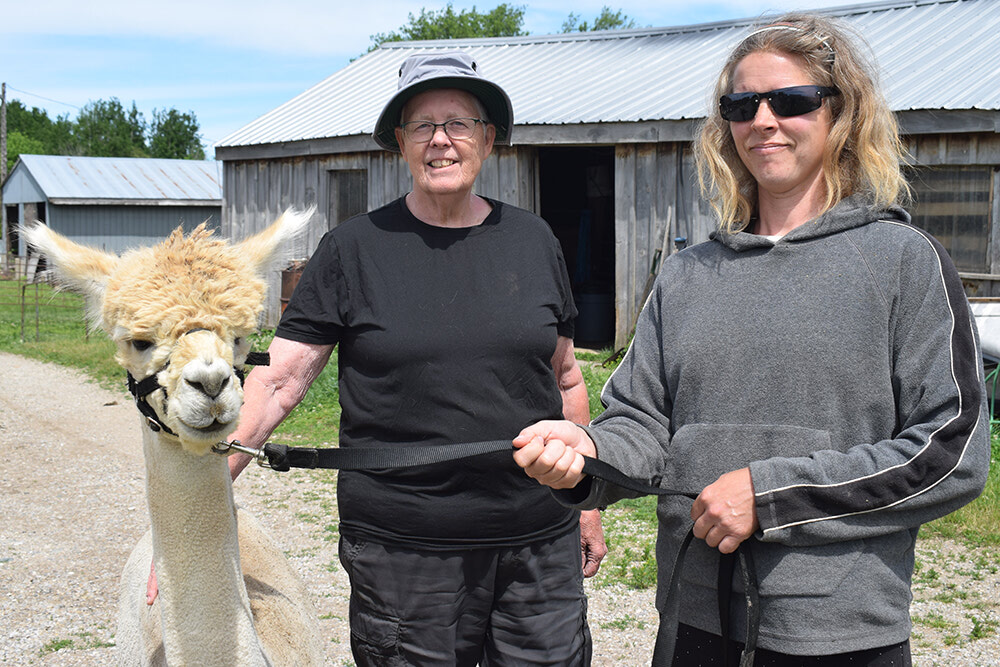
Grahams' alpaca "Heaven's Just Fabulous" wins further honours
BY SCOTT STEPHENSON
There’s likely not a female alpaca in all of Huron County that wouldn’t consider DL Farms Alpacas’ latest champion to be quite the catch. The aptly named “Heaven’s Just Fabulous” is the total package - a three-year-old, light fawn male with as fine a micron as an alpaca half his age. Fabulous also has solid confirmation, a top line in good proportion and balance to the rest of his body, and holds a great degree of density - all very desirable traits in an alpaca.
But don’t go thinking this huacaya alpaca is just a pretty face. From his very first show, Fabulous has been consistently cleaning up at competitions all over Ontario, collecting championships and earning fleece awards for the consistency and quality of his hair.
In his first two years of competition alone, Fabulous took home notable prizes like Mature Male Light Halter and Reserve Champion Light at the Royal Winter Alpaca Show, and Supreme Halter Male and Supreme Walking Fleece at the Rockton World’s Fair Alpaca Show. In 2025, he was named Huacaya Fleece of the Year as well as the coveted Fleece of the Year at the Annual Point Awards.
His 2026 record is already shaping up to be equally impressive. Most recently, Fabulous took the Colour Champion title at the Alpaca Ontario Spring Show, as well as a first-place finish in the Mature Light Male Halter category.
To learn a little more about the ins and outs of breeding such a show-worthy alpaca, The Citizen stopped by the Graham family farm on Amberley Road for a quick chat with Dee and Adria Graham about what makes this particular ungulate so hard to beat.
From a technical standpoint, alpaca showing is all about fleece quality, which accounts for 60 per cent of an animal’s score. Conformation accounts for the remaining 40 per cent. Judges evaluate everything from fibre micron count and density to body structure and overall health, including a hands-on inspection in the ring.
Dee told The Citizen that alpacas are evaluated across 22 natural colour classifications, ranging from dark tones through to lighter shades like the fawn-coloured Fabulous. More than one judge has remarked that, compared to other three-year old alpacas, Fabulous’ fleece has remained unusually fine - a quality more frequently found in younger animals.
While Fabulous’ ever-expanding list of accolades has made him a most desirable sire, his future in the breeding barn remains a work in progress. “He hasn’t found his mojo,” Adria announced with a laugh. “He just smells flowers.”
While Fabulous has not yet picked up on any of the sensual signals being sent his way by a multitude of mate-able maidens, Dee and Adria are both confident that he’ll figure it out any day now. They know from experience that, in the alpaca world, reaching maturity just takes time, sometimes. “We had another male that was almost five before he figured out that he could have a good time,” Dee recollected.
The Grahams’ entry into alpaca farming began unexpectedly in 2006, when a young art student from Lucknow happened to observe the guard llamas protecting Dee’s flock of 300 or so sheep. The llama talk soon sparked a conversation about other kinds of camelid, and before they knew it, both teacher and student had each purchased their own pair of alpacas. The beasts soon went forth and multiplied, as is their wont. “Now it has become an obsession,” Adria explained.
Dee was quickly won over by these intelligent and mild-tempered creatures. “These animals, by far, are the nicest animals I have ever worked with,” she pointed out. “They just wheedle their way into your heart.” She added that, compared to other livestock, alpacas are quick to train for the show ring. “You put a halter on them, and within two weeks I could go in the show ring,” Dee explained. “With a foal, a calf, a sheep - anything like that - it takes months of working with them.”
Beyond the show ring, DL Farms Alpacas operates a farm-based retail and mecca of alpaca education. They offer tours by donation only, in the hopes that a pay-what-you-can system will make alpaca farming more accessible to more people. “We don’t charge a regular fee because that limits a lot of people who can’t afford $75 for an hour’s time with an alpaca,” Dee explained. “I’d rather have people come and enjoy themselves.”
The farm produces a range of alpaca fibre goods, with wool from its own herd sheared, cleaned and processed through a local mill into yarn and felt. Dee dyes and knits items such as socks, hats and sweaters. Their on-farm store also offers alpaca products sourced through fair trade relationships with artisans in Peru.
Once Heaven’s Just Fabulous decides to settle down, the Grahams hope that all the qualities that make him such a success in the show ring will be passed on to his offspring, but only time will tell. “You never know what you’re going to get,” Dee told The Citizen. “You spin the dice, and you hope to heaven that what you’ve done in the preliminaries and the breeding works, and all of the chromosomes and the alleles line up, and you get something that is… just fabulous.”