
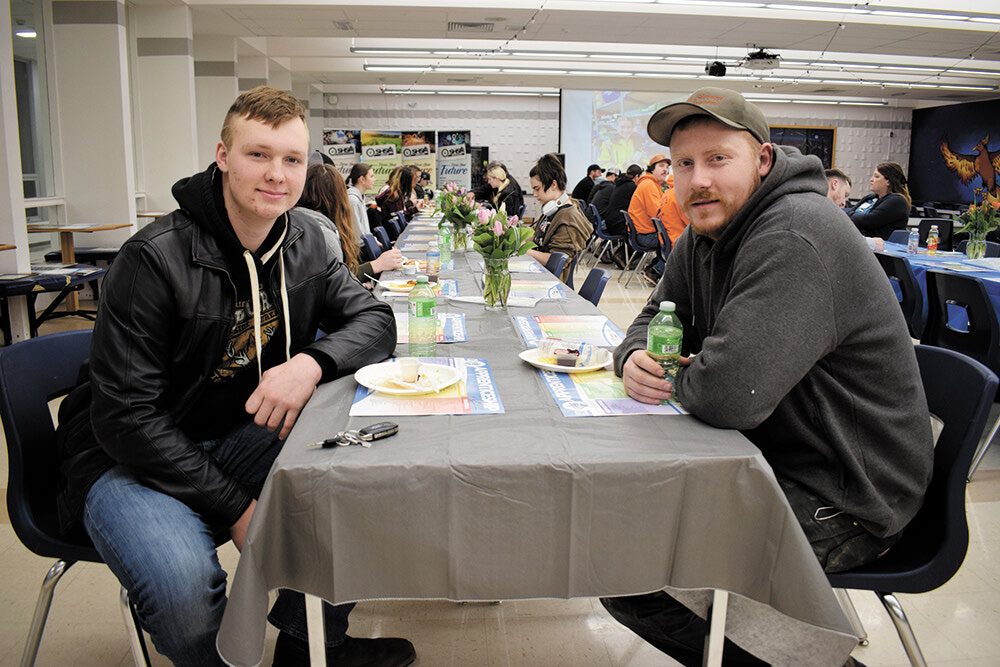
CHSS honours co-op students, businesses with bi-annual breakfast
BY SCOTT STEPHENSON
Every student learns differently. Some excel in the traditional classroom or lecture hall, while others discover their strengths through doing, building, observing and engaging directly with the world around them. Recognizing and valuing those differences is key to helping young people unlock the confidence and sense of direction they need to thrive as adults. One shining example of the power of embracing a more hands-on approach to education is Central Huron Secondary School’s (CHSS) Co-op Program, which pairs students with all manner of local businesses for a semester of on-the-job learning.
From the very beginning, a key component of the program has been the biannual showing of gratitude to program participants by way of a celebratory breakfast. Shane Taylor has been running the co-op program for 15 years, and he is confident that its ongoing success rests squarely on the shoulders of all the community partners willing to open their doors to students. “It’s unbelievable - the businesses in our community and the things that they do,” he declared at last Wednesday’s breakfast event. “We have some phenomenal manufacturing, the healthcare system, the trades, the radio stations - everything you can imagine - without everyone in this room, our students don’t have anywhere to go and they don’t have any experiences to live off.”
Students are spoiled for choice when it comes to finding a business interested in participating in the program. Tanner Boven of Ferguson Plumbing, Heating and Electrical has been seeing students around the shop for years, but last semester, he finally took on his first co-op student - 12th grader Lukas Greidanus from Londesborough. Boven sees why Ferguson’s is so popular with students. “We have all three trades, so they get a taste of all different kinds of jobs,” he pointed out. “All those trades are so hands-on, and they can learn so much. It’s way better than sitting in the classroom, for sure.”
The two mostly spent the semester roughing in bathrooms and cutting and laying pipe. For Greidanus, the experience helped confirm his future plans. After graduation, he intends to do an apprenticeship at Ferguson’s. “I was interested in plumbing already - I have a couple of plumbing people in my family,” he told The Citizen. “My favourite experience was roughing in the water lines of a brand new house in Clinton.”
Not all co-op placements follow a nine-to-five schedule. Tori Kennedy didn’t mind flying solo to the co-op breakfast - that’s just the life she chose when she elected to do her placement at a radio station. Her mentors, Matt Hussey and Fadi Didi, had to mind the airwaves that morning and were unable to attend. Kennedy normally joins them from 6 a.m until 9 a.m. on the air - it’s an experience she has found illuminating. Before her placement, Kennedy hadn’t pictured herself behind a microphone. “I just wanted to do something technology-based,” she recalled. “I just really like technology and photography and stuff like that, and then this came up as an opportunity. I took it… and now I’m debating it as my career path! It’s opened my eyes to how many different technology fields link into things I can go for - there’s just a ton of different opportunities!”
In healthcare, co-op placements can be both eye-opening and demanding. As a paramedic with Huron County Paramedic Services, Joel Sibbert says the program helps students figure out if they are well-suited to the realities of such a challenging job. “There’s a huge shortage of paramedics in the province right now,” Sibbert pointed out. “When we have co-op students in, we have the opportunity to show these kids that this is a potential avenue for a career in healthcare. A lot of times, when people think of healthcare, they think doctors, nurses, that sort of thing, where paramedicine is a completely different field within healthcare.”
Sibbert explained that paramedicine goes far beyond clinical settings. “We have to provide medical treatment, but we also have the logistics of getting the person from wherever they find themselves to the hospital. You’re dealing with weather, extricating people from a car that’s been involved in a car accident. If they’ve fallen, we’re wherever they’ve fallen to. We get into industrial places. We get into marine things. You’re practising medicine in a very uncontrolled environment,” he said.
Of course, paramedic co-op students aren’t just thrown into the deep end - student safety and scope of practice are always front of mind. “The co-op students are nonclinical,” he assured The Citizen. “Most of the time, their role on a call is strictly observational. They carry the bags, help with cleaning the vehicles, cleaning up after a call, and that sort of thing. We try to get as much hands-on training as we can, but within their scope of practice, which is important, obviously, when you’re dealing with medical emergencies.” Sibbert knows that there’s a certain type of student who excels in that environment. “It should be someone who is interested in healthcare, but also somebody who thrives on the unknown and the unpredictable. Every day is different,” he said.
Grade 12 student Cohen Lammerant might just fit that description. While he wouldn’t recommend his paramedic placement to everyone, it was just the right fit for him. “I want to do this as a job when I get older, so I figured I might as well,” Lammerant reasoned. “And it’s really cool. I get to do different stuff every day. I’m always on the move, so I’m never really sitting in one place for too long. And it’s exposed me to a bunch of stuff that you need to know if you want to do this job - injuries and all that stuff.”
At Huronview Home for the Aged, co-op placements offer students a chance to explore meaningful work in long-term care. When Bryce Dale first imagined his placement, he pictured himself in the kitchen. “I originally went there to be a cook in the kitchen,” he explained. “Then I figured I might as well just start trying a bunch of different positions within Huronview… I’ve ended up sticking with activation. And at the moment, I will be going to college for that. It’s basically getting all of the residents active - playing games, moving around, kind of keeping their mobility while making it fun. Two days ago, we were bowling, so we set up a bowling alley in the main lobby.”
Rebecca Cabral and Mackenzie McGavin, who also work in activation at Huronview, see clear benefits for both residents and students like Dale. “Our residents love to have younger staff and younger students in, because they get to learn from them and it makes them feel useful again. And I think it’s really great for the students, because sometimes long-term care can be intimidating for people,” Cabral said.
McGavin believes that trying out all the positions available in elder care gives students a unique perspective. “Bryce gets to see all those aspects of building the emotional, intellectual, spiritual and physical connection - he did get a very well-rounded education at Huronview,” she opined.
Cody Bromley may have been teaching at CHSS for four years, but he finds that working with co-op students to be very educational. “This is my first year in the co-op program under Shane Taylor, who’s been an excellent lead, and a mentor for me,” he said. Bromley has seen firsthand how co-op can shift a student’s perspective on learning. “They see it as true work - they see the potential in what they’re doing, and the need for it. It’s not just ‘sit down - we need to do this before we’re moving on to the next thing,’” he noted. “We saw a lot of nervous energy early on in the semester, and then, midway through, especially after live demonstration meetings, you could see that strength - almost a gumption - from getting to do what they like and show off…. It’s been awesome to see the students that may not see themselves as a typical student thriving in a workplace environment, and hearing back from the community that they’re an integral part of the company or the placement. It’s really motivating to hear and to see how well the students are doing in the world.”
Twice a year, CHSS takes the time to say thank you to the local employers and mentors that help make the co-op program into a reality. Every breakfast over the years has been a simple but meaningful gesture of appreciation for the businesses and organizations that invest their time, expertise and trust in students. But the co-op breakfast is about more than gratitude - it’s living proof that learning doesn’t look the same for everybody, and a reminder of what can be accomplished when students are given the support to become the best versions of themselves.